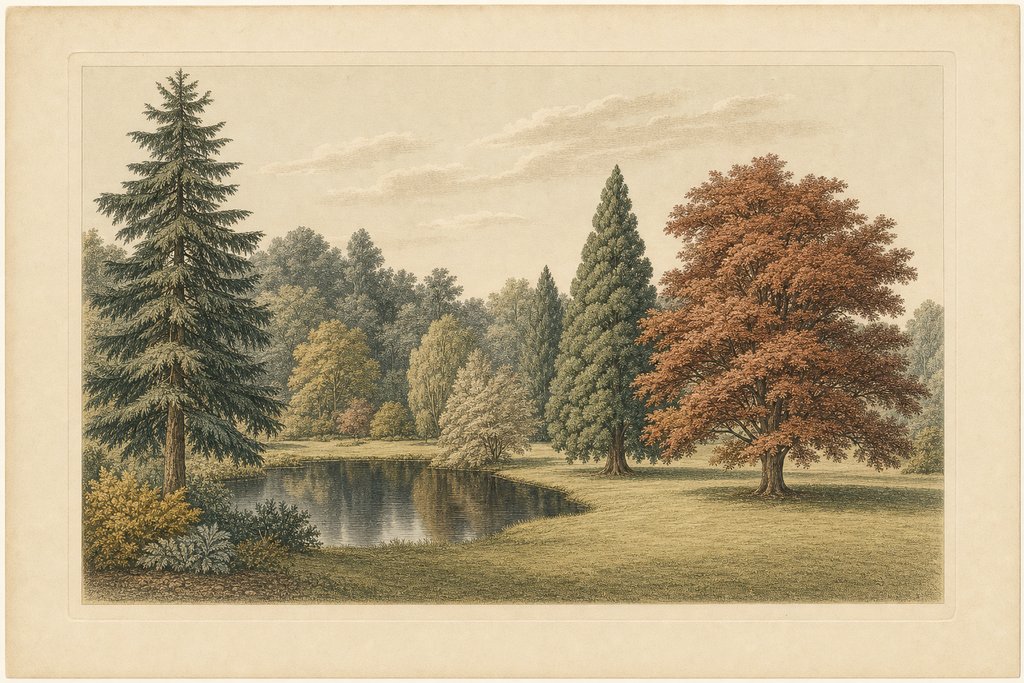
The park divides into three bands that behave quite differently underfoot. Close to the car park sit the visitor centre, tearoom, walled garden and lawns on level bound surfaces. Beyond them lies the arboretum. Past that, the ground opens into forest rides and sandy heath that continue for miles into Thetford Forest without any boundary you would notice.
That last point surprises people more than anything else here. No fence marks where the thirty managed acres end and the wider forest begins, so a short circuit turns into a long one without warning. The waymark discs on the posts are the practical answer, and following one colour is the reliable way back to where you started.
Almost everything a visitor needs sits within about two hundred metres of the car park: the information point, toilets, tearoom, play area, the walled garden and the start of every waymarked route. It is worth knowing this if mobility, small children or a short window of time shape the visit, because the useful part is genuinely compact.
The arboretum is why the park looks unlike the forest around it. Conifers planted from the 1820s have reached full size on ground that carried none before, so redwoods, cedars and pines of unusual stature stand in open grass, not in plantation ranks. It reads as a collection, not a wood, because that is what it was built to be.
The pond sits below the lawns and holds the usual mix of waterfowl, edged by planting that softens it into the grass. It is small, and it is not the reason to come, but it anchors the open part of the park and gives the shortest circuit something to bend around. Benches sit along its northern side.
The walled garden is easy to miss because its entrance reads as a gap in brick rather than a gateway. Inside, the old kitchen garden of the estate now carries ornamental planting and seating within the original walls, which hold warmth and shelter on days when the open parkland is being scoured by wind off the heath.
Further out, the Gothic mausoleum stands alone in a clearing enclosed by pines. It is a genuinely odd thing to meet on a walk, built of knapped local flint with pale stone dressings and no apparent purpose in the landscape around it. It is reached from the longer waymarked routes instead of from the lawns.
The forest rides beyond the arboretum are wide, straight and sandy, laid out for forestry and not for walking. They make easy fast walking and reasonable cycling, but they look alike at junctions in a way that catches people out, particularly where three or four meet at an oblique angle under uniform pine.
The heath is the part most worth slowing down for. Open, low and sandy, it carries plants and birds that exist almost nowhere else in Britain, and it is why the Brecks are protected. It also offers no shade and no shelter at all, which matters in both July and January more than newcomers tend to expect.
If time is short, the surfaced circuit through the arboretum shows the collection, the pond and the walled garden without leaving firm ground. If there is an afternoon, one of the longer coloured routes reaches the mausoleum and the heath edge. The trails page sets out distance, surface and gradient for each one.
Navigation here rewards a small amount of preparation. Phone signal is patchy under the canopy, the rides are not signposted by destination, and one stand of pine looks very much like another once you are three junctions in. Noting your waymark colour at the start costs nothing and solves almost every problem that follows.
Common questions
How long does it take to see the park?
The managed core takes about an hour at an unhurried pace, covering the arboretum, pond, walled garden and lawns on firm level ground. Adding one of the longer waymarked circuits out to the mausoleum or the heath edge brings a visit to roughly two and a half hours, depending on which colour you follow.
Where does the park end and the forest begin?
There is no marked boundary, which is the single most common source of confusion. The managed thirty acres give way to Forestry England land without a fence or a gate, and the rides continue for miles. Following one waymark colour keeps you on a defined circuit that returns to the visitor centre.
Is there anywhere sheltered if the weather turns?
The walled garden holds warmth and blocks wind, and the tearoom and visitor centre offer the only indoor space on site. Beyond the arboretum there is effectively no shelter at all, because the heath is open and the forest rides funnel wind instead of breaking it, so turning back early is often the sensible call.
What wildlife is a visitor likely to see?
Waterfowl on the pond are the most reliable sighting near the lawns. On the open heath, woodlark sing from early spring and nightjar churr along the pine edges at dusk in summer. Deer, mostly roe and muntjac, move through the surrounding forest and are easiest to spot early in the morning while the rides are quiet.
Written by Eleanor Hollis, walks and access editor. Layout and surface descriptions come from walking the ground; the extent of managed parkland against wider Forestry England land is taken from published boundary mapping and not from what is visible on the ground, because no fence or gate marks the change anywhere along it.