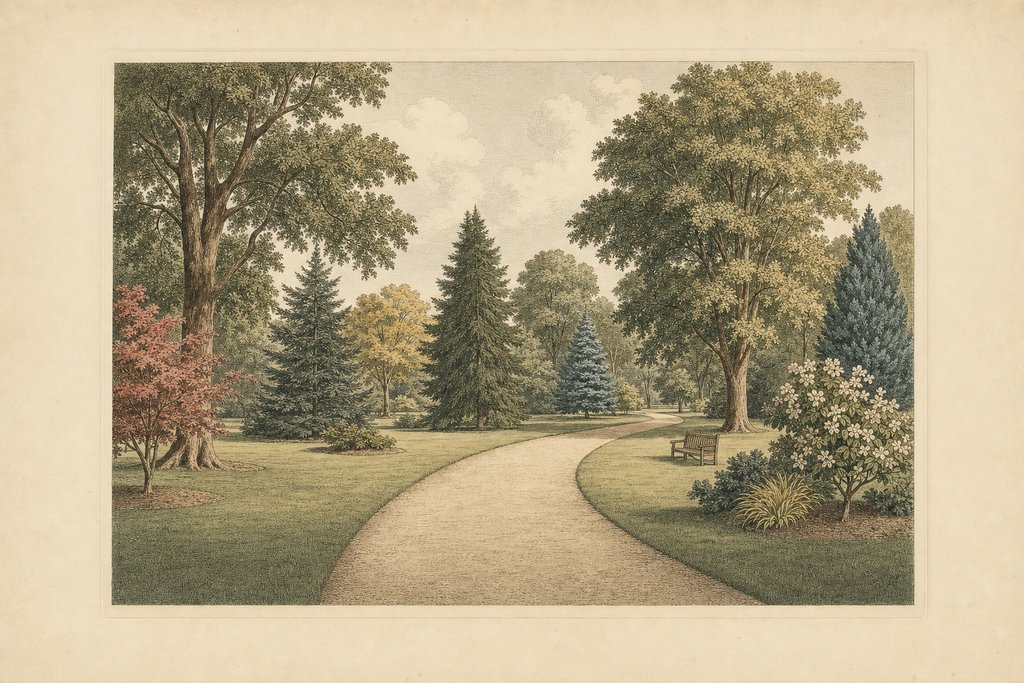
The honest summary of accessibility at Brandon Country Park is that the site splits sharply in two. The managed core around the visitor centre is level, made ground and works for most people. Everything beyond the arboretum runs on blown sand, pine litter and exposed root, and that ground defeats wheels regardless of how determined the person pushing them is.
This page deliberately carries no gate widths, gradient ratios or measured distances. Those numbers are exactly what someone would plan a trip around, and publishing unverified ones would be worse than publishing none at all. What follows describes surfaces and barriers as walked, alongside what the park operator itself states about its own routes.
The accessible trails: surfaces that hold up
The park's own published position is that the Redwood Trail, formerly the Red Trail, is suitable for pushchairs and for all-terrain wheelchairs. That wording repays attention. An all-terrain chair is a different machine from a standard manual chair, and the distinction matters more here than the word suitable might suggest on a first reading.
It is the first of the accessible trails: the surface is made ground for its full mile, which is why it holds up across seasons when the outer routes do not. It takes in the arboretum, the pond and the open lawns, so it is not a compromise route but the part of the park most people come to see.
Mobility scooters raise a separate question from chairs. A scooter with small wheels and low clearance behaves much like a standard chair on this ground, while a larger off-road model copes better with packed surfaces. Soft sand takes more power to cross than tarmac, so anyone heading beyond the made circuit should allow a generous margin for the return leg.
Level ground for a wheelchair or a pushchair
The area immediately around the visitor centre is the most reliably level ground on the site. The building holds the information point and toilets, with the tearoom in the adjoining range and its courtyard seating outside. Distances between those things are short, which matters when fatigue rather than surface is the limiting factor.
Blue badge parking sits close to the visitor centre on firm surfacing, and badge holders are exempt from the parking charge when displaying correctly. The practical point is proximity: the difference between a designated bay and the far end of the car park is enough to matter on a difficult day, whatever the surface underfoot.
Not every surface is one of the accessible trails: the walled garden is worth knowing about for a different reason. Its brick holds warmth and blocks the wind that crosses the open parkland, which makes it usable on days when the exposed ground is unpleasant. Seating inside means a visit can be paced around rests rather than around distance covered.
Timing makes a noticeable difference for anyone who needs space. Saturday mornings bring the parkrun field through the car park and onto the rides, and weekend afternoons in the school holidays fill the courtyard and the paths around the pond. A weekday visit tends to mean free bays near the building, quieter paths and room to pass without waiting.
Where accessibility at Brandon Country Park stops
Beyond the arboretum, conditions change within a few hundred metres and they change for the worse. Blown sand gives under any wheel, tree root crosses the line of the path at intervals, and deep pine litter holds water in the hollows for days after rain. None of it is waymarked as difficult, because it is not difficult on foot.
Nothing on the site is signed for accessibility at Brandon Country Park by gradient or surface type, so a route cannot be assessed from the waymark post beforehand. That is worth knowing in advance. The change from made ground to sand happens at the far edge of the arboretum, and it is obvious the moment you reach it.
Anyone whose visit depends on specific measurements of accessibility at Brandon Country Park should contact West Suffolk Council directly, since the council manages the site and holds whatever survey information exists. Conditions underfoot also shift with the season here more than on a surfaced urban path, which is worth factoring into any plan made well in advance.
Common questions
Can a standard manual wheelchair use the park?
The made ground around the visitor centre, the tearoom and the walled garden is level and firm, and that area covers a good deal of what people come for. The park's own wording for the Redwood circuit specifies all-terrain wheelchairs, which suggests a standard manual chair may find parts of it harder going.
Which route should I choose with a pushchair?
The Redwood Trail, which the park describes as suitable for pushchairs and runs a mile on made ground around the managed core. Avoid the Forest and Heath and the Firecrest routes, where the surface turns to blown sand and exposed root a few hundred metres past the arboretum and stays that way.
Are there accessible toilets?
Facilities are at the visitor centre, alongside the information point and the tearoom, on the most level ground on the site. Because provision and opening hours are set by West Suffolk Council and the site operator and can change, confirm current arrangements with them before a visit that depends on them.
Is an assistance dog welcome throughout the park?
Dogs are welcome across the parkland and on every waymarked route, so an assistance dog can go wherever its handler can, and the tearoom courtyard seating is dog friendly. In spring and early summer the open heath holds ground-nesting birds, and close control is expected there, which a working dog on harness already provides.
Written by Eleanor Hollis, walks and access editor. The suitability wording for the Redwood circuit is the park operator's own. Everything else here describes surfaces and barriers as walked across the year, and carries no measured figures at all, because none has been independently surveyed for this guide and estimates would not be safe to plan around.