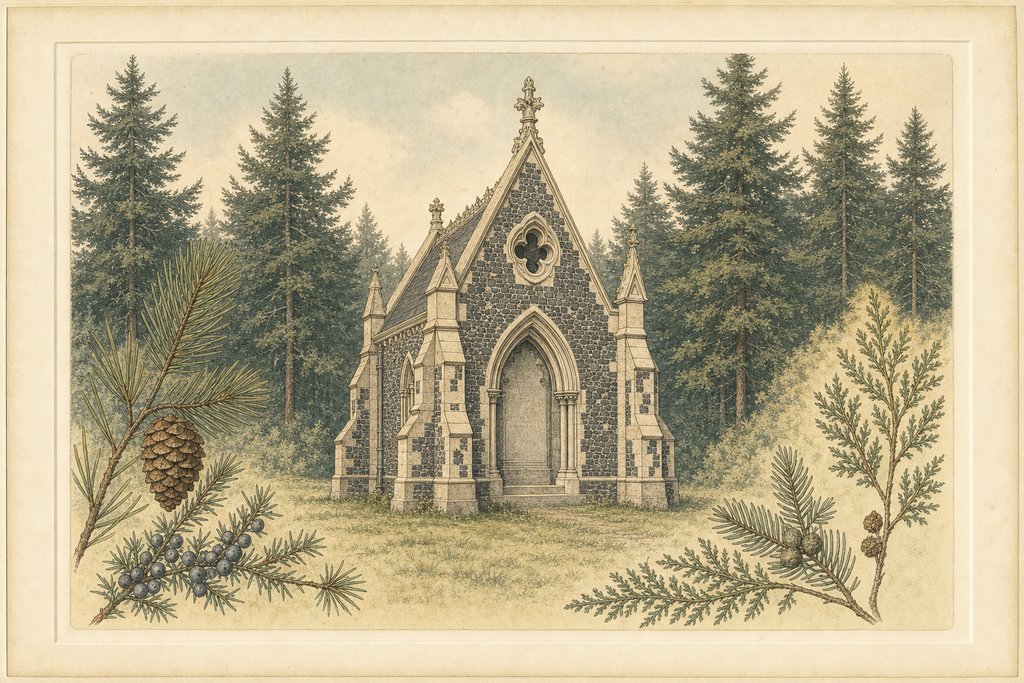
Brandon Country Park history starts because one man decided to plant trees on ground that had almost none, and because he had the money to do it at a scale nobody local could match. Edward Bliss bought the Brandon estate in the early nineteenth century and began setting a collection into open sandy breck from the 1820s onwards.
Gunflints, and the money that paid for the planting
The money came from gunflints. Brandon was the centre of that trade, and for a long stretch of the eighteenth and nineteenth centuries it supplied the British military on a scale that is difficult to picture now. Knappers here worked flint into firearm flints by hand, in volumes that ran into millions during the Napoleonic Wars.
Flint was the reason Brandon existed as anything more than a village. The chalk beneath the Brecks carries seams of exceptionally pure black floorstone flint, and the town sat directly on top of the best of it. Skill and geology together produced an industry that outlasted the weapons it was originally built to arm.
A gunflint had to fracture to a precise edge and strike a reliable spark thousands of times. Knappers worked seated, striking prepared cores with a hammer to detach blades, then squaring each one by eye. It was piecework, it was skilled, and it left the flint waste that still turns up in the forest floor.
The arboretum Bliss planted
Bliss planted into a landscape that had been open warren and sheepwalk for centuries, ground thin enough that most owners would not have attempted a collection on it at all. What he chose were the fashionable introductions of his period, including conifers newly arrived from North America and the Mediterranean that nobody nearby had yet grown to any size.
Those choices are the part of Brandon Country Park history still standing. Giant redwoods, cedars and other specimen conifers were set with space around them so each could develop its full form, and two centuries of growth on free-draining sand has produced trees of a stature that sits oddly against the low heath beyond.
The walled garden belongs to the same period and the same ambition. It was the estate's kitchen garden, built to hold warmth and shelter in a place where wind crosses open ground without interruption, and its brick still performs that function for visitors long after it stopped producing food for a household.
The mausoleum in the pines
The mausoleum is the oddest survival. Bliss had it built in the Gothic manner from knapped local flint with pale stone dressings, set deliberately apart in a clearing that the planting has since enclosed completely. It is a private tomb in a public park, and it accounts for most of the questions asked at the visitor centre.
Local tradition holds that the clearing is haunted, and the building does very little to discourage the idea. It is austere, windowless in effect, and surrounded by dense evergreen that kills sound. Whatever one makes of the stories, the atmosphere around it is genuinely unlike anywhere else on the site.
How the Brandon Country Park history ends up public
The estate eventually passed into public hands, and the managed thirty acres became the country park that West Suffolk Council runs today. Thetford Forest grew up around it from the 1920s onwards as the Forestry Commission planted the Brecks at scale, which is why park and plantation now run into one another without a boundary.
Older than any Brandon Country Park history, three and a half miles to the north-east lies Grimes Graves, a Neolithic flint mine complex where people were sinking shafts for the same seams four thousand years before Brandon's knappers worked them commercially. The continuity is remarkable: one material, one landscape, and an industry returning to it across an almost unbroken span.
Common questions
Who was Edward Bliss?
He was the nineteenth century owner of the Brandon estate who created the arboretum, planting a collection of specimen trees into open sandy breck from the 1820s onwards. His wealth came from the gunflint trade, and the Gothic mausoleum standing in the pines beyond the arboretum was built as his tomb.
Why was Brandon important for gunflints?
The chalk under the Brecks holds seams of exceptionally pure black floorstone flint, and Brandon sat on the best of it. That geology, combined with generations of accumulated knapping skill in the town, made it the centre of British gunflint production, supplying the military in enormous quantities during the Napoleonic Wars.
Can you go inside the mausoleum?
No. It is a private tomb rather than a monument arranged for visitors, and it stands closed in its clearing beyond the arboretum. It can be reached and viewed from outside on the longer waymarked routes, which is how most people encounter it, usually without expecting to find it there at all.
Where does the name Brecks come from?
The word breck is medieval. It described an area of heathland broken up for cultivation for a time and then allowed to return to wild ground. That pattern of ploughing and abandonment shaped the open sandy country Bliss planted into, and the wider region, Breckland, still carries the name of the practice today.
Written by Ross Bramwell, heritage and landscape editor. This account draws on published histories of the Brandon gunflint industry and of Breckland estate planting, together with the park operator's own published material on the arboretum and the mausoleum. It does not rest on unpublished archive research, and dates are given as the published sources give them.