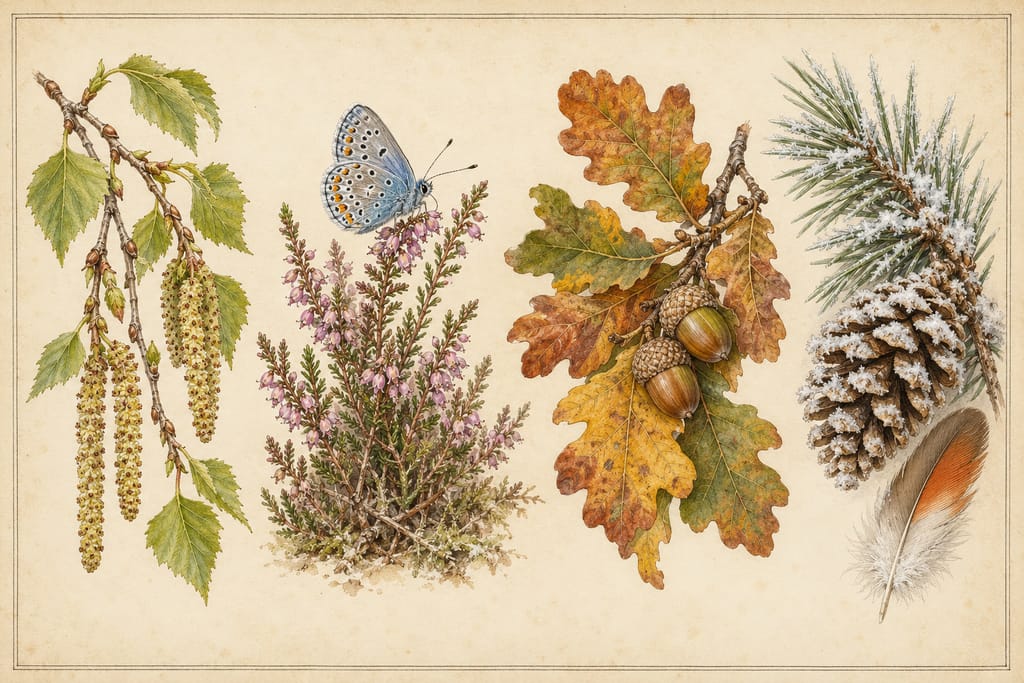
This is where conditions, seasons and landscape notes collect, kept separately from the route and visiting pages, which are meant to stay stable. A country park built on sand changes character more sharply through the year than most places do, and some of that is worth recording as it happens.
Autumn is the season the Brecks are least known for and arguably the best. Pine litter across the outer rides produces a genuinely good fungi season through October, with boletes and earthstars among the species that reliably appear, and the light through plantation at that time of year is worth the walk on its own.
It is also the wettest period underfoot. The hollows beneath heavy pine hold water for days after rain that the sandy sections shed within hours, so the same circuit can be quick in one stretch and slow in the next. Boots stop being optional on the longer routes from about September onward.
Fungi here are worth looking at and photographing. Picking is a different matter: much of the surrounding land is managed by Forestry England, rules vary by site and season, and several species in Breckland pine are scarce. Identification errors in this group are also unusually unforgiving, which is reason enough for caution.
Spring brings the birds the Brecks are protected for. Woodlark hold territory on the open sandy ground from early in the season, and nightjar arrive later to churr at dusk along the pine fringes. Both nest on or near the ground, which is why close control of dogs matters here in a way it does not elsewhere.
The stone-curlew is the bird the wider Brecks are best known for among birdwatchers, and the region holds most of the British breeding population. It nests on bare, stony or closely grazed ground, on arable fields and fenced heath reserves well away from busy paths, and it depends on being left undisturbed in a way few birds do.
Midsummer is the quietest time to walk the long routes and the hardest. The heath carries no shade whatsoever, the sandy sections loosen in dry heat, and the middle of the day is genuinely unpleasant on the Firecrest. Early morning and late evening are transformed, and the light at both ends is exceptional.
Forestry work changes the view from one year to the next. Thetford Forest is a working plantation, and when a block is felled and replanted, the sunny ground left behind is briefly closer to heath than to forest. Woodlark and nightjar move into those restocking areas, so a cleared stand can become a good place to listen at dusk.
August colours the heather across the open ground, which is the one week people photograph and the one week the heath looks like the postcard. It passes quickly. The rest of the year the same ground reads as low, brown and unremarkable to anyone not looking closely at what grows on it.
The plants that make Breckland special are small and easy to step over. Its dry grassland supports rare annuals that grow on disturbed sandy ground, many of them flowering low to the turf in spring. A hand lens and a patient eye do more here than a long walk, and track edges often hold more than the open heath.
Winter strips the park back to structure, and the arboretum benefits most. Bare branches make the architecture of each specimen legible in a way summer foliage hides completely, and the long views across the heath open up once the bracken has gone down. Light goes early under canopy, which is the constraint.
Deer are the mammals visitors most often see. Roe and muntjac live throughout the plantations of Thetford Forest, and the small muntjac is common enough that a quiet walker at dawn has a fair chance of a sighting. Their slots show in the soft sand after a dry night, often crossing the path at the same point.
Every seasonal note here comes with the same caveat: a washed-out day on this ground cannot be salvaged, because the heath offers nothing to shelter under and the rides funnel the wind along their length. Thetford and Bury St Edmunds hold the nearest indoor options, and a forecast checked the night before saves most wasted journeys out here.
- London's famous parks, and what a country park does differently — designed urban landscape set against working heath and forest.
- Events through the year — the fungi forays, night walks and seasonal trails that recur here.
- The history of the park — Edward Bliss, the gunflint trade and the arboretum planted into bare sand.
Common questions
When is the best time of year to visit?
It depends entirely on what you want. October gives the fungi and the best light through the plantation. Spring brings the woodlark and nightjar that the Brecks are protected for. August colours the heather for a week or so, and winter opens the long views and shows the arboretum's structure most clearly.
Is the ground usable in winter?
The made surfaces around the visitor centre and on the Redwood circuit hold up all year without difficulty. The longer routes are a different question: sandy stretches drain fast and walk well, while the hollows under heavy pine stay soft for days after rain, so conditions vary within a single circuit.
Can I pick the fungi?
Treat it as a look-only activity unless you have checked the position for the exact piece of land you are standing on. Much of the surrounding forest is managed by Forestry England, the rules differ by site and by season, several Breckland species are scarce, and misidentification in this group carries real consequences.
Are ticks a problem on the heath and forest rides?
Ticks occur across heath, bracken and deer country throughout the Brecks, mostly from spring to autumn. Long trousers tucked into socks help on the narrower paths, and a quick check of skin and of any dog after the walk is sensible. Remove a tick promptly with a proper tool, and seek medical advice if a rash develops.
Written by Eleanor Hollis, walks and access editor. Seasonal notes describe what has been observed on the ground across several years and not anything formally surveyed. The species mentioned are those that appear reliably here year after year, and not a complete or authoritative list of what occurs across the wider Brecks.