The Tree Trail works on a different principle from the other routes. It is not a circuit measured in miles but a self-guided walk through the arboretum collection, and its subject is the planting itself. The park describes it as a walk through a world of trees, which is a fair summary of the experience.
A leaflet from the visitor centre carries the key, and the route is considerably harder to follow without one. That is worth knowing before setting out, because the specimens are not individually signed in the way a botanic garden would sign them, and several of the more interesting ones are easy to walk past.
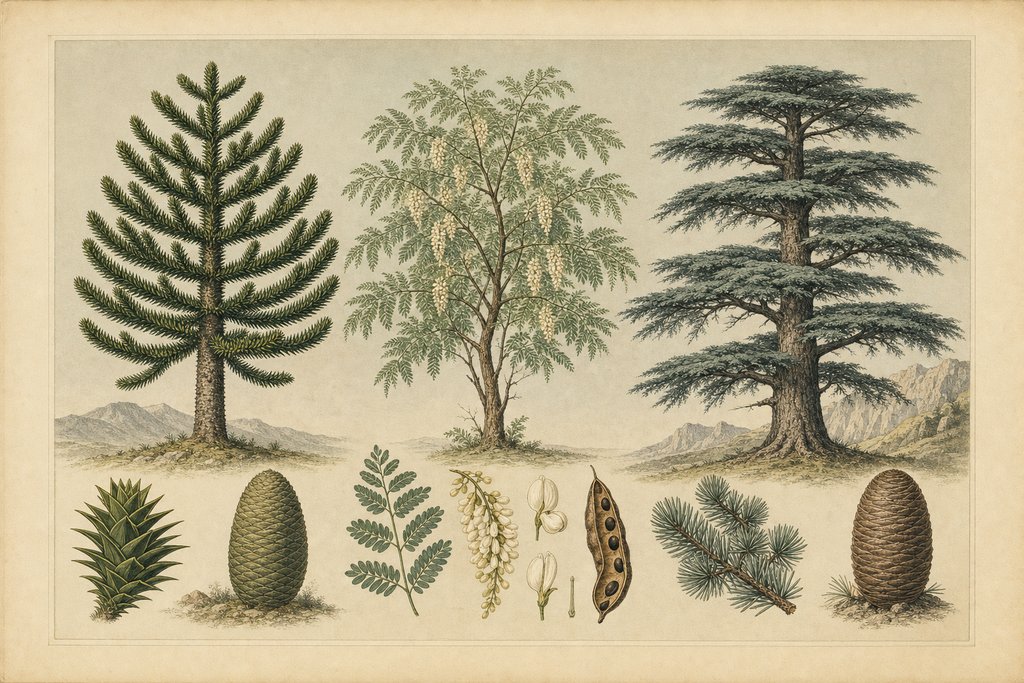
What the collection contains is genuinely unusual for this part of Suffolk. False acacia, monkey puzzle and giant redwoods stand among cedars and pines on ground that carried almost no trees at all two centuries ago. The park names those three specifically, and they are the ones most visitors remember afterwards.
The man behind the collection was Edward Bliss, who bought Brandon Park in 1820 with money made selling gunflints during the Napoleonic Wars. He laid out the arboretum with exotic species, among them Blue Atlas cedar, monkey puzzle and giant redwoods, and his workforce later planted over a million trees on the estate and the land around it.
An arboretum is a collection, not a wood. Specimens were set in open grass so each could reach full form and be seen from every side, which is why the trees here stand apart instead of competing in ranks. Two centuries on, that spacing is exactly what makes their scale legible.
The giant redwoods are the pieces that stop people. Native to a narrow band of the Sierra Nevada, they were among the fashionable introductions of the mid nineteenth century, and specimens planted here have had long enough to show what the species does when nothing competes with it for light.
Monkey puzzle is the other reliable surprise, and it looks wrong in an English park in a way that never quite wears off however often you see it. Its whorled, rigid, spine-tipped branches belong to a Chilean forest and to a far older world than the beech and oak that frame it here.
Blue Atlas cedar is easy to pick out once you know what to look for. The needles carry a silvery blue cast, held in tufts along stiff branches that rise at the tips, and older trees spread into broad layered shapes. It comes from the Atlas Mountains of North Africa, a long way from Suffolk sand.
False acacia rewards a closer look than it usually gets. The pinnate foliage is light and open, the bark deeply furrowed on older trunks, and the whole tree carries itself quite unlike anything native growing near it. It is a North American species that took to the dry sandy ground here better than most introductions did.
The route suits a slow hour and rewards returning in different seasons. Bare winter structure shows the architecture of each specimen far better than summer foliage does, while spring and early summer bring the flowering and the fresh growth that make the broadleaves easier to tell apart at a distance.
Reading the trees gets easier with a few habits. Look at the bark first, then the way the branches leave the trunk, then the needles or leaves up close, and finally the whole silhouette from a distance. Fallen cones and leaves under each tree are useful clues as well, and a phone camera makes comparing them afterwards simple.
Because it stays within the arboretum, the walking is easy throughout and the ground is the firmest in the park. That makes it a good option in poor conditions, when the outer routes turn soft, and a sensible pairing with the Redwood Trail if you want a short visit that covers both the collection and the open parkland.
The leaflet dependency is worth planning around, because the visitor centre keeps shorter hours than the park itself. Arriving on a winter afternoon to find the key unavailable turns the route into an ordinary walk through pleasant grass, which is the one way this particular trail can disappoint people who came for it.
Common questions
Do I need the leaflet?
It helps considerably. The specimens are not individually labelled in the way a botanic garden labels its collection, so the leaflet from the visitor centre is what turns a pleasant walk among large trees into a route you can actually follow. Pick one up before setting out rather than afterwards.
How long is the Tree Trail?
The park presents it as a self-guided walk instead of a circuit with a stated distance, and it stays within the arboretum. An unhurried hour covers it comfortably. The ground is level and firm throughout, so the time you spend is governed by how long you look at each specimen.
When is the best time to walk it?
Winter shows the structure of each specimen most clearly, because bare branches make the architecture of a tree legible in a way that dense summer foliage simply hides. Spring and early summer are better for telling the broadleaves apart, since fresh growth and flowering give you a great deal more to work from.
Can I combine the Tree Trail with another route?
Yes, and it pairs easily with the Redwood Trail, since both stay within the managed parkland close to the visitor centre. Walking the collection first and then the mile around the pond and lawns makes a relaxed half day on firm ground. The walled garden nearby adds another short stop to the same visit.
Written by Ross Bramwell, heritage and landscape editor. The named species and the description of the route as self-guided come from the park operator's own published material, while the notes on the collection itself draw on published accounts of nineteenth century planting across the Brecks and its introduced conifer collections.