The Redwood Trail is the shortest of the waymarked routes and the only one that stays inside the managed parkland for its whole length. The park gives it as a one mile circuit around the heart of the site, on made ground throughout, and describes it as suitable for pushchairs and all-terrain wheelchairs.
It was called the Red Trail until the routes were renamed after 2015, and a good deal of printed material still uses that name. Both refer to the same circuit. If you are following an older leaflet or a guidebook from before the change, the red waymark and the redwood waymark mark the same posts on the ground.
The route works as an introduction to what the park actually is, which is a nineteenth century planted collection and not a piece of forest. It passes through the arboretum, skirts the pond and crosses the open lawns, so the specimen conifers, the water and the mown grass all appear within a mile of easy walking.
Everything that defeats wheels on the longer routes — loose blown sand, exposed tree root, deep pine litter — lies beyond the arboretum. The Redwood never reaches it. That is why this circuit holds up through a wet autumn when the Firecrest and the Forest and Heath are slow going for anyone on anything other than boots.
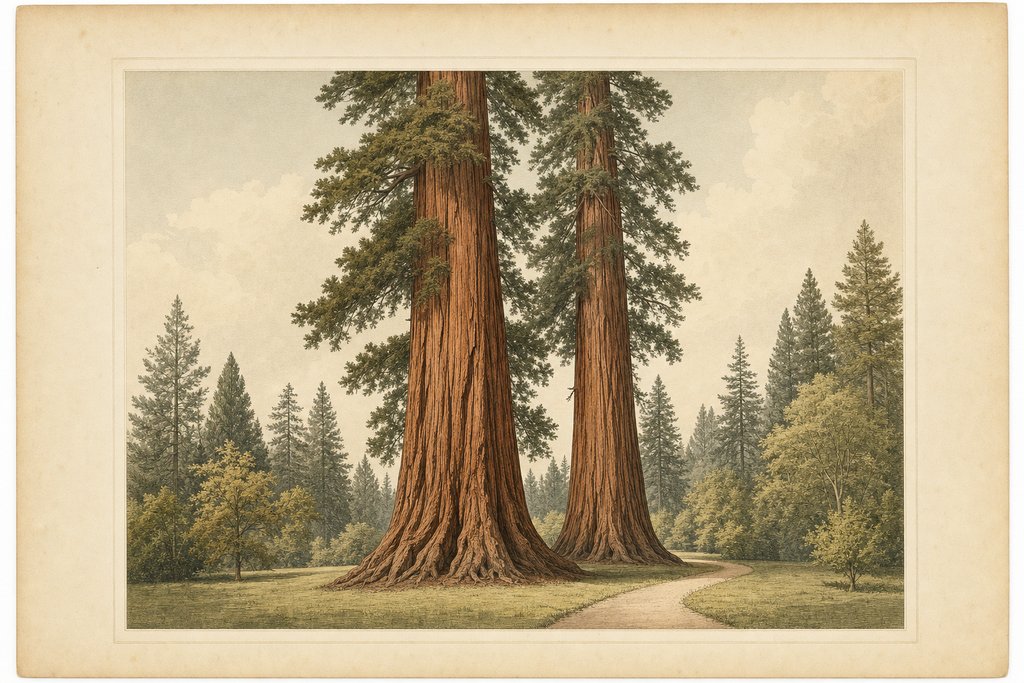
The giant redwoods that give the trail its current name are among the more startling things in the collection. Planted from the 1820s onward into ground that had carried almost no trees, they have reached a size that reads oddly against the low sandy heath a few hundred metres away, and they are unmistakable once you know to look up.
The arboretum this circuit passes through was the work of Edward Bliss, who bought Brandon Park in 1820 using money from the gunflint trade of the Napoleonic Wars. Alongside the exotic specimens he laid out a walled garden, and when the flint business fell away his workforce planted more than a million trees across the surrounding land.
Elsewhere in the park is something many visitors miss: the Gothic mausoleum Bliss built in knapped flint, ringed by Irish yews. He and his wife were first buried there and later moved to the town cemetery. The flintwork is a local craft in its own right, and it ties the estate to the industry that paid for it.
Start and finish are at the visitor centre, which means toilets, the information point and the tearoom sit at both ends of the walk. For a first visit, or a visit with small children or anyone who tires quickly, that matters more than the scenery. Nothing on this circuit is more than a few minutes from the building.
Pace it at forty minutes if you are walking steadily, or closer to an hour and a half with children who stop at everything. The surface asks nothing of ordinary shoes in any season, which is unusual here, and the gradients are gentle enough that they register as changes in view more than as effort.
The circuit suits a short winter afternoon particularly well. Light goes early under the canopy and the longer routes become a poor idea once it does, but a mile on made ground near the centre stays sensible when the day is closing in. The bare arboretum also shows its structure better without leaf.
If the Redwood turns out to be too short, the natural next step is the Forest and Heath Trail, which starts the same way before crossing out of the park. That change of surface is abrupt and worth feeling before committing to a longer route, because it is the thing that decides whether the outer trails suit you.
A mile of easy ground suits more than first visits. Older visitors who want a regular walk without uneven footing use it as a steady circuit, and it pairs naturally with the walled garden or the Tree Trail for anyone who wants a longer stay without moving onto loose sand. It also suits a slow pace with frequent stops.
Common questions
Is the Redwood Trail genuinely wheelchair accessible?
The park describes it as suitable for all-terrain wheelchairs and pushchairs, and it stays on made ground for its full mile. That wording matters a great deal: an all-terrain chair is not the same thing as a standard manual chair on tarmac, so the accessibility page sets out what the surfaces actually are.
Is this the same as the Red Trail?
Yes. The routes were renamed from colours to park names after 2015, and the Red Trail became the Redwood Trail. The waymarked circuit on the ground did not change. Older leaflets, websites and guidebooks still refer to the red route, and both names describe the same one mile loop around the managed core.
How long does it take?
Around forty minutes at a steady walking pace, and closer to an hour and a half with young children or anyone stopping to look at the collection properly. The circuit is a mile on level made ground, so the time is governed by how often you stop rather than by the difficulty of the walking.
Is the Redwood Trail good for children on bikes or scooters?
The firm made surface suits small wheels far better than the outer routes, where sand stops balance bikes dead. It is still a walking circuit near the visitor centre, so busy weekends call for a slow pace and an eye on walkers. Quieter weekday mornings give young riders much more room to practise.
Written by Eleanor Hollis, walks and access editor. The distance and the pushchair and all-terrain wheelchair description are the park operator's own published figures and not an independent survey. The surface notes come from walking the circuit, which holds up as firm made ground for its whole length in every season we have walked it.