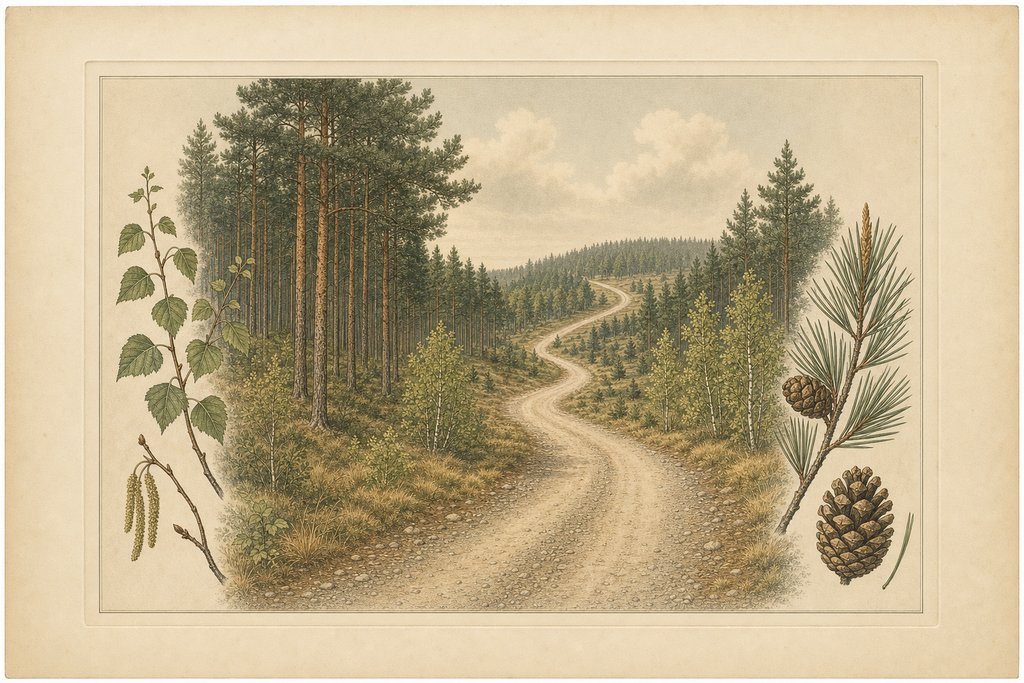
The Poacher is the only one of the five laid out for bikes, and the park describes it as over eight miles of well marked wide paths, narrow tracks and undulating drives through the heart of Thetford Forest. It is a proper ride rather than a walking route that happens to permit cycling.
Setting off from the visitor centre has practical advantages for riders. The car park is the obvious place to unload, the tearoom and toilets are there at the end, and the waymarking for this route starts from the same point as the walking trails. Check the disc colour before leaving, since more than one route leaves from here.
Surface is the thing that decides whether you enjoy it. Much of the route runs on compacted sand and gravel drives that ride beautifully, but the narrow sections carry loose sand, exposed root and pine litter. A hybrid or mountain bike handles all of it; anything on narrow tyres will struggle on the softer stretches.
The undulation is constant and gentle. There is no climb here that would register anywhere hilly, but eight miles of low rises on a surface that gives slightly underfoot adds up more than the flat profile suggests, particularly into a headwind on the more exposed sections where the plantation opens out onto heath.
The route crosses and briefly shares walking trails near the visitor centre, where foot traffic is heaviest at weekends and in school holidays. Speed there is worth giving up voluntarily. Further out the drives are wide enough that walkers, riders and horses pass one another without anyone having to stop.
Navigation is easier than on the walking circuits, because the drives are broader and the waymarking follows them consistently. The same caution applies at oblique junctions, though: the plantation looks alike in every direction, and a wrong turn taken at speed puts distance behind you before you notice it has happened.
Group rides work well here because the drives are wide enough to ride two abreast without blocking anyone. On the narrow linking sections the group stretches out quickly, and it pays to agree a regrouping point at each obvious junction. Waiting where the plantation opens gives everyone a clear view of who is still behind.
Allow an hour and a half to two hours at a relaxed pace with stops, or closer to an hour if you ride it steadily and know the line. The route connects into the wider Thetford Forest network without any boundary, so extending it is trivially easy and shortening it is not, which is the usual pattern here.
Conditions favour the rider more than the walker across the year. Sandy drives that walk slowly roll well, and the surfaces that hold water are mostly on the narrow linking sections and not on the main drives. Hard winter ground is genuinely quick, and high summer can leave the softest corners loose enough to wash a front wheel.
Timber work is a normal part of the forest year, since this is a working plantation managed for its wood. Felling and extraction can close or divert sections of the wider network for weeks, and machinery leaves ruts on drives that were smooth a month earlier. Signs at the affected points take priority over the waymarks.
Bring everything you need with you. There is no water, no shelter and no repair point anywhere on the route, and phone signal comes and goes under canopy. A spare tube matters more here than on a road ride, because a puncture two miles into the forest is a long walk back in cycling shoes.
The route's name points at real local history. Thetford Forest was planted across what had been open warren and heath, ground worked for centuries by people who took rabbits and game from it, legally and otherwise. Poaching was a genuine rural economy here long before any of these drives were cut through the plantation.
The forest the route runs through is younger than it looks. Thetford Forest was planted by the Forestry Commission after the First World War, with the first land bought in 1922, and most of it went in within twenty years. Corsican pine now dominates, and its straight ranks are what give the drives their long sightlines.
Common questions
What sort of bike do I need?
A hybrid or mountain bike is the right tool. The main drives are compacted sand and gravel that almost anything would handle, but the narrow linking sections carry loose sand, exposed root and pine litter. Narrow tyres bog down in the soft corners and make an enjoyable ride into hard work.
Is it suitable for children?
Confident young riders manage it, since there is no technical difficulty and no real climb anywhere on the circuit. Eight miles on a surface that gives underfoot is the limiting factor instead of any single feature, so judge it on stamina and on how far they normally ride without complaint.
Can I ride the walking trails instead?
They are shared use in places, but the walking circuits are narrower and busiest close to the visitor centre, where families and dogs naturally concentrate. The Poacher exists precisely so that riders have a route of their own, and using it keeps the pinch points around the parkland clear at weekends.
Do I have to ride the whole circuit?
No, though shortening it is awkward. The route is waymarked as a loop of over eight miles, and the forest drives that cross it are not signed back toward the visitor centre. Riders wanting a shorter outing usually go out along the route for a set time and then retrace their wheel tracks to the start.
Written by Eleanor Hollis, walks and access editor. The distance and the route description are the park operator's own published figures and have not been independently surveyed. Surface behaviour, timings and seasonal conditions come from riding the circuit across the year, and conditions on the narrow linking sections change more than the main drives do.