Wild food sessions here run as tasters rather than as courses, and the distinction matters because a taster sets out to change how you look at a hedgerow instead of sending you home with a bag. The Brecks give them an unusual list to work from, which is the real reason to do one locally.
Free-draining sand over chalk produces a different plant community from the heavy clays elsewhere in East Anglia, so the species that turn up reliably here are not quite the ones a general foraging walk would cover. Guides who know the ground tend to lean into that and not working a standard list.
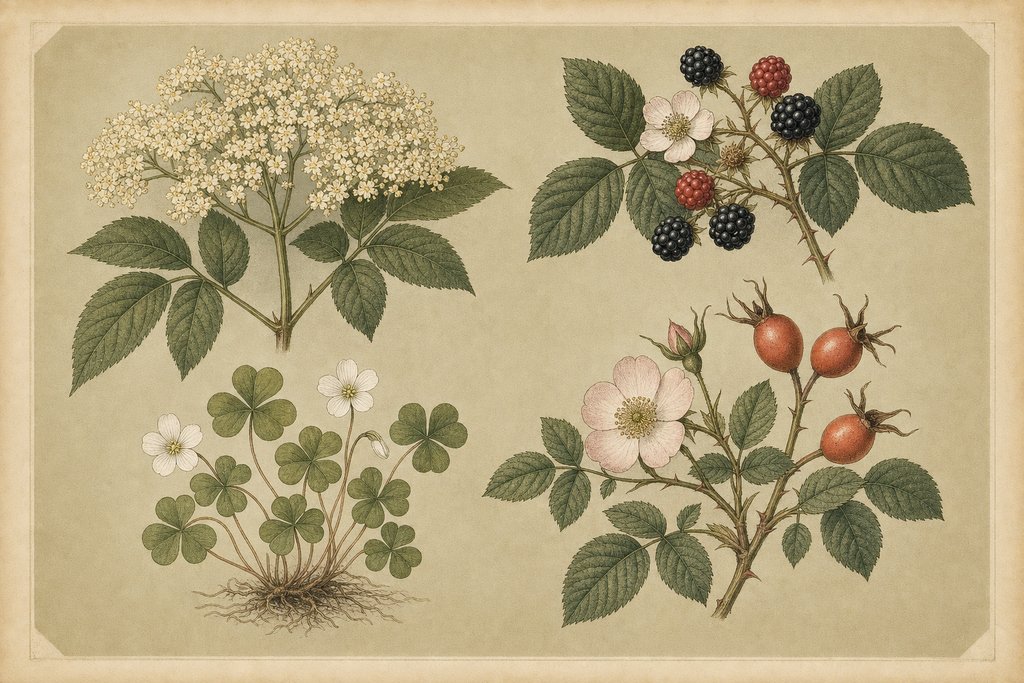
Summer sessions run on the hedgerow and woodland-edge species, which are the most forgiving introduction. Elder in flower, early blackberry and the common woodland herbs are abundant, easy to identify with confidence, and hard to confuse with anything that would do you any real harm if you happened to get it wrong.
Autumn shifts the emphasis to fruit and to fungi, and the fungi half is where the caution comes in. Rosehips, sloes and late blackberry are straightforward. The fungus groups that fruit on this pine litter include several that punish a confident misidentification, which is precisely why the guides here treat that group separately from the rest.
Midwinter tasters are the least obvious and often the most interesting, because the list shrinks to roots, barks and the few evergreen leaves worth knowing. With the foliage gone, identification depends on bud, bark and form instead, which is a genuinely different and considerably more demanding skill to practise properly.
One rule holds right across the country. Under the Wildlife and Countryside Act 1981 it is an offence to uproot any wild plant without the landowner's permission, which matters more in midwinter than in summer, because roots are where the season's interest lies. It is the reason those sessions tend to examine roots far more often than they dig them.
What every session spends real time on is what not to pick. Much of the surrounding land is managed by Forestry England, rules vary by site and by season, and several Breckland species are scarce enough that taking them matters regardless of what any general foraging guidance published elsewhere happens to say about them.
The sessions suit adults and older children, and they work best for people who want to learn to look instead of to collect. Anyone expecting to fill a basket will be disappointed, and that expectation is worth adjusting before booking instead of discovering it an hour into the walk itself, when it is too late.
Anyone with allergies or a sensitive stomach should say so when booking. Wild plants are new to most digestive systems, and a guide can steer someone away from a species or a quantity that would be a poor idea for them. Pregnancy is worth mentioning too, since several common hedgerow herbs carry advice against eating them while pregnant.
Dates and booking come from West Suffolk Council and from the organisations running individual sessions, and numbers are capped because a large group cannot gather around a single plant usefully. High winds cancel forest events at short notice, so a quick check on the morning itself is always worth the small amount of trouble.
The sessions also change how you read the ordinary edges of a walk afterwards. Verges, hedge bottoms and the scrubby margins of a car park stop being background once you can name what grows there, and that shift in attention is the part participants report long after the details fade.
A small notebook does more work than a phone. Sketching a leaf shape, noting where a plant grew and what grew beside it, and writing down the guide's warning about its lookalike builds a record that is far more useful a year later than a camera roll of green close-ups taken in poor light under trees.
Good sessions move slowly and cover few species, which can feel thin to anyone expecting a long list. Learning one plant properly, including the things it is confused with and the state it is in across a year, is worth more than photographing twenty and remembering none of them clearly.
Common questions
Will I be able to take food home?
Probably not, and that is not really the point of a taster session. These walks are built to teach you how to identify and how to look at ground you already pass, and much of the surrounding forest is managed land where collecting is restricted by site and by season anyway.
Is foraging legal here?
It depends entirely on the exact piece of ground you are standing on, which is precisely why the sessions spend time on it. Much of the surrounding forest is Forestry England land, the rules vary by site and season, and several Breckland species here are simply too scarce to take responsibly at all.
Are these sessions suitable for children?
Older children do well, particularly in summer when the hedgerow species are abundant and easy to identify with real confidence. Younger ones find the pace slow, and the autumn sessions cover fungi, where a confident misidentification carries consequences that make close and continuous adult supervision genuinely essential throughout the session.
What should I bring to a foraging taster?
Boots for the woodland edge, a notebook and pencil, and gloves if nettles are likely to be handled. A hand lens helps with hairs, veins and leaf margins. Containers matter far less than people expect, because tasters focus on identification, and a bottle of water for rinsing hands before tasting anything is more useful than a basket.
Written by Ross Bramwell, heritage and landscape editor. Species and seasonality here follow published accounts of Breckland flora, and nothing on this page is a licence to collect anywhere: permissions are set by West Suffolk Council and by Forestry England, and they vary considerably by site, by species and by season.