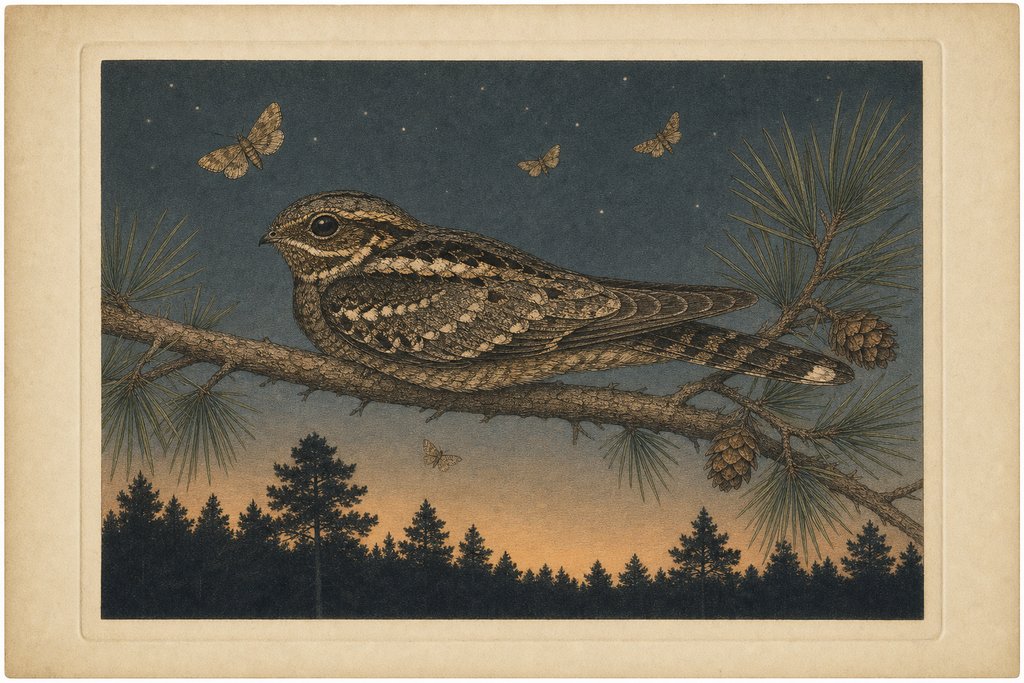
Guided after-dark walks run here through the warmer months, and they are one of the few events at this park that would be genuinely hard to replicate elsewhere in the county. The reason is the nightjar, a bird that breeds on open heath and is almost impossible to encounter without going out at dusk deliberately.
Nightjars arrive from Africa in late spring and hold territory on the sandy heath through midsummer. The male's churring song is a long mechanical trill that carries across open ground and stops abruptly, and hearing it for the first time is genuinely disorienting because nothing else in the British countryside sounds like it.
They are easier to hear than to see, and easier to see in silhouette than in any detail. The usual encounter is a long-winged shape crossing an open ride against the last of the light, often much closer than expected, because the birds hawk for moths along exactly the clearings that a walking group tends to stand in.
Binoculars are worth bringing despite the fading light. A pair with large objective lenses gathers enough of the afterglow to turn a passing silhouette into a bird, and on a good evening the white wing patches of a displaying male show clearly. They cost nothing in night vision either, since they give off no light of their own.
These walks start late and depend on it. Nightjar activity peaks in the narrow window after sunset, and bats emerge on a similar schedule, so a session that begins too early spends its time waiting. That is why the advertised start is later than most park events and why punctuality actually matters.
Bats are the other half of the evening, and the forest rides suit them well because a straight cleared corridor through plantation concentrates flying insects. Handheld detectors convert their calls into something audible, which turns an empty-looking ride into obvious activity and is usually the part that younger participants remember.
Several species use the site, and the detector makes the differences between them legible by frequency and rhythm rather than by sight. Pipistrelles are the ones most often picked up over the open ground, and the larger species tend to work higher and along the tree line where the rides meet the canopy.
Other sounds fill the gaps between the churring. Tawny owls call from the plantation, and a single harsh bark out of the darkness is very often a muntjac, a small deer that is common across Thetford Forest and alarming the first time it goes off close by. Guides tend to name these as they come, which keeps the waiting lively.
What to bring is mostly about staying comfortable while standing still. Open Breckland heath loses heat fast after sunset even in July, and the group spends a good deal of time stationary and quiet. A warm layer beyond what the walk out seems to need is the single most useful thing to pack.
Ticks are the less romantic side of standing in heath and long grass at dusk, carried through the forest by the same deer. Long trousers tucked into socks are a sensible precaution on these walks, and a careful check of skin and clothing back at home is a habit worth keeping after any evening spent in vegetation.
Leave the torch off, or use a red filter if you must have one. Night vision takes twenty minutes to build and a moment of white light to destroy, for you and for everyone standing near you. Guides will ask for this, and it is the request most often forgotten within the first quarter of an hour.
Phones are best left in a pocket on silent. A lit screen does the same damage to night vision as a white torch, and a ringtone carries a long way over open heath. Anyone wanting a keepsake of the evening will get more from a sound recording of the churring than from a photograph of a dark sky.
Numbers are limited and these sessions book out early, partly because the season is short and partly because a large group cannot move quietly enough to be useful. Dates come from West Suffolk Council and from the organisations running them, and high winds will cancel a forest walk at short notice.
Common questions
What time do night walks start?
Later than most park events, because nightjar and bat activity both peak in the window shortly after sunset, and the exact time therefore shifts across the season. Check the published start for the specific date, and arrive punctually, since a group that sets off late misses the best part of the evening.
Are they suitable for children?
Older children who can stay quiet and still for reasonably long stretches do well, and the bat detectors tend to be the highlight for them. Younger ones find the late start and the standing about difficult, and noise genuinely reduces what the whole group hears, so judge it on temperament.
Will we definitely see a nightjar?
No, and any guide who promises otherwise is overselling it badly. Hearing one churring is very likely in season and in reasonable conditions; actually seeing one is a matter of luck and light. Cold, wet or windy evenings reduce both, which is part of why these walks are so weather-dependent.
Do I need my own bat detector?
Not for a single walk, though it is worth asking when booking whether detectors are provided and passed round the group. Anyone who gets hooked can buy a basic heterodyne model, which is tuned by hand to one frequency at a time; pipistrelles show up clearly at around forty-five kilohertz and make a good first species.
Written by Eleanor Hollis, walks and access editor. Species behaviour and seasonality here follow published accounts of Breckland heath ecology; dates, prices and booking for individual walks are set by West Suffolk Council and by the organisations delivering them, and are deliberately not reproduced on this page because they change from season to season.