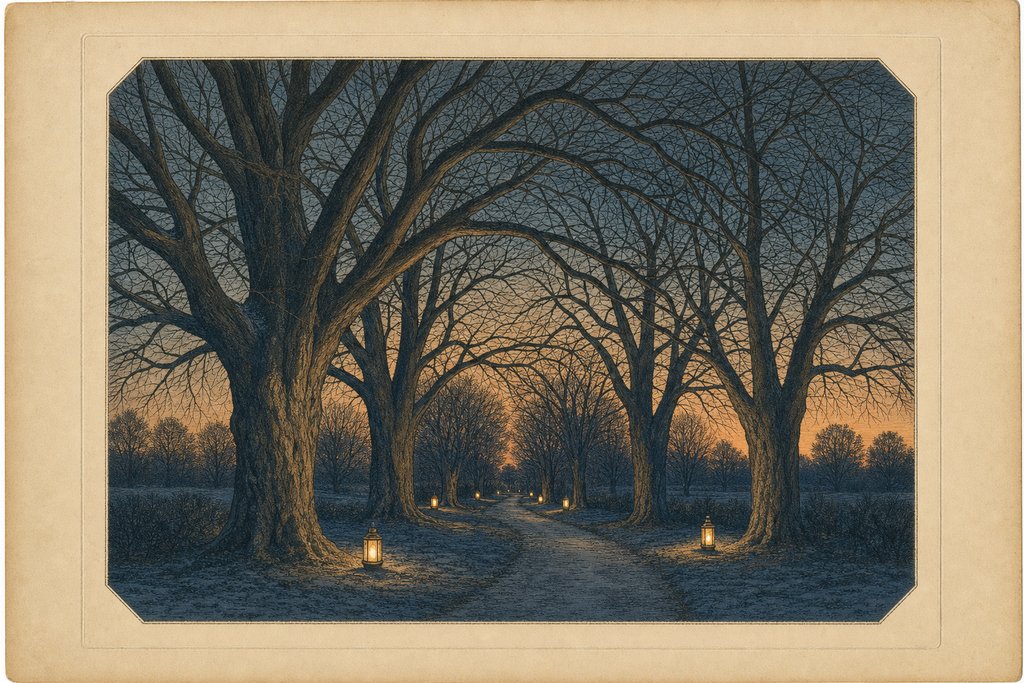
Lantern walks pair a making session with a walk, and they run in the part of the year when the park is dark by mid-afternoon. Participants build a lantern indoors, then carry it out through the arboretum once the light has gone entirely, which is a simple idea that works considerably better than it sounds.
The arboretum is the right setting for this and not merely a convenient one. Specimen trees planted for their form read completely differently by lantern light, when a single trunk or a low branch is lit from underneath and everything beyond it disappears into the dark rather than receding gradually.
Making comes first, usually from jars, paper and tea lights or small battery units. It occupies the part of the session when it is not yet dark enough to walk, which is a sensible piece of scheduling, and it gives younger children something to carry that they have a genuine stake in.
The lantern goes home afterwards, and for many children that is half the appeal. A jar lantern survives the car journey if it travels upright in a box, and fitted with a fresh battery light it can make a second appearance on the next dark evening at home, which stretches a short session a good deal further.
The walk itself is short and stays on made ground near the visitor centre. That is a deliberate choice: the outer routes are unsuitable after dark for anyone who is not equipped for them, and a lantern gives you atmosphere and not any useful quantity of light to walk by.
These sessions suit younger children particularly well, and they are one of the very few events here that work for an age group still too young for the night safaris. The walk is short enough not to exhaust anyone, and the making holds attention during the long wait for darkness.
Photographs are harder than they look. Phone cameras push the exposure up and turn a warm pool of lantern light into a grey, grainy wash, so better pictures come from holding still, tapping on the lantern itself to set the exposure, and letting the background fall away to black, which is how the evening looks to the eye anyway.
Dress for standing still in the cold instead of for walking briskly in it. Midwinter evenings on this ground are genuinely cold once the sun has gone down, the group moves slowly, and a good deal of the session is spent standing still while lanterns are lit and everyone is gathered.
Arriving with time in hand helps more than usual. The making starts while there is still some light outside, and a family that turns up late misses the calm part of the evening and joins at its busiest moment. An early arrival also means the car park and the route to the meeting point are found in whatever light remains.
Numbers are capped, because a lantern walk with sixty people becomes a procession instead of an experience, and because the making session needs close supervision throughout. These sessions book out earlier than most events here, helped by falling in a part of the calendar with very little else on offer outdoors.
Dates and booking come from West Suffolk Council and from the organisations that deliver the individual sessions. As with every forest event here, high winds will cancel one at short notice for genuine safety reasons, so a confirmation on the day itself is worth having before travelling any real distance.
The timing of these walks is bound to the turning year and not to a programme. They run when darkness arrives early enough for a family session to finish at a reasonable hour, which is a narrow window, and that scarcity is part of why they hold their appeal so reliably.
Whether a lantern carries a flame or a small battery unit changes the evening more than it sounds. A battery light survives the walk back in wind and removes the one hazard that would otherwise sit awkwardly alongside the youngest participants. A flame gives the better light and asks for closer supervision.
Common questions
What age are lantern walks aimed at?
Younger children, broadly, and they fill a gap that the after-dark wildlife walks cannot. The making session holds attention while everyone waits for darkness, and the walk itself is short and on level ground, so it suits an age group that would find a night safari far too long and too demanding.
Do we make the lanterns ourselves?
Yes, and that is normally the whole first half of the session. Materials are provided, the construction is simple enough for small hands with a little help, and the point is that each child carries something they made instead of something handed to them at the start of the walk.
How far do we walk?
Not far at all, and that is entirely deliberate on the organisers' part. The route stays on made ground close to the visitor centre, because the outer trails are genuinely unsuitable after dark and because a lantern provides atmosphere instead of any practical quantity of light to navigate a forest ride by.
Can we bring a lantern from home?
Ask the organiser when booking, though the making is really the point and materials are supplied for it. A shop-bought lantern skips the half of the session that holds younger children during the wait for darkness. If a family wants a spare for the walk back to the car, a small battery torch serves that purpose better.
Written by Eleanor Hollis, walks and access editor. The description here reflects how these sessions have run across several recent winters, and the format has been stable. Dates, prices, materials and booking arrangements are set by West Suffolk Council and by the organisations delivering them, and are not reproduced anywhere on this page.