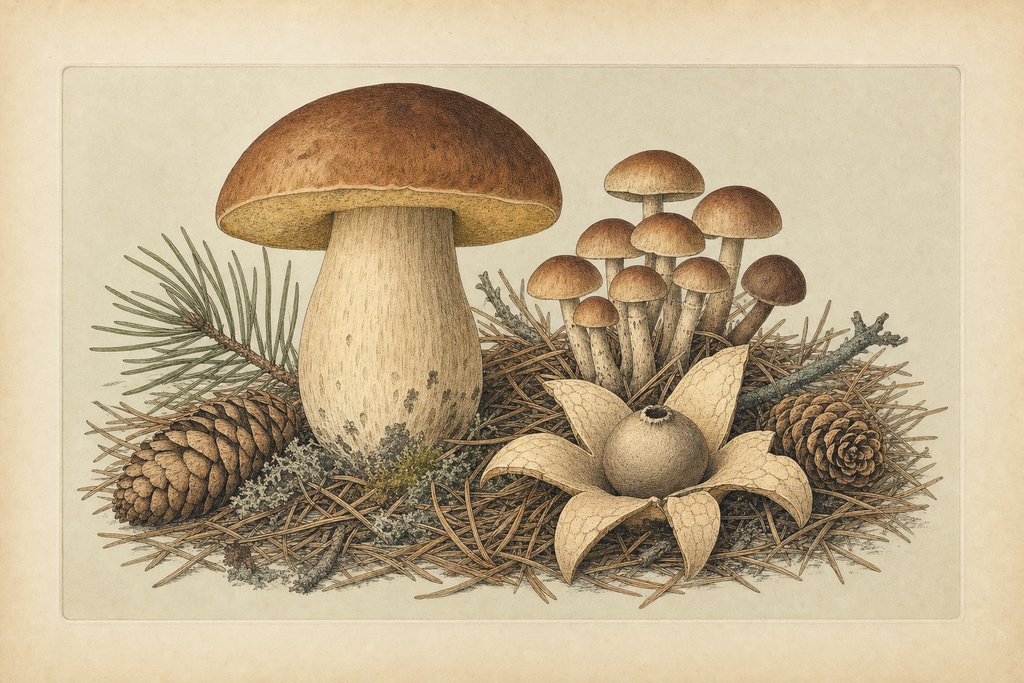
Autumn is the season this park is least known for and probably its best, and the fungi are a large part of why. Guided forays run through October, and the pine litter across the outer rides produces with a consistency that makes the walks worth booking well before the month starts.
Conifer plantation on sand is a specific habitat and it produces a specific community. Boletes do well in it, forming partnerships with pine roots that mean the same spots fruit year after year, and earthstars turn up on the litter in a way they rarely do on heavier ground elsewhere in East Anglia.
The walking itself covers very little distance. A foray can spend twenty minutes within sight of its starting point, because a good patch of litter rewards slow attention, and the group moves on only once it has been worked through. Anyone expecting a brisk circuit should adjust, and anyone with limited mobility will often find the pace suits them.
Earthstars are the ones that stop people. The outer layer of the fruiting body splits and peels back into rays that lift the whole structure clear of the litter, so what you find looks less like a mushroom than a small engineered object sitting on the forest floor with no obvious explanation.
These walks are about identification rather than collection. Much of the surrounding land is managed by Forestry England, rules vary by site and season, several Breckland species are scarce, and the consequences of getting an identification wrong in this group are more serious than in almost any other kind of foraging.
The Brecks add species that a general fungus walk elsewhere would not turn up, because the combination of free-draining sand, planted conifer and remnant heath is unusual. Guides here tend to lean into that and not working through a standard list, which is what makes a local foray more interesting than a generic one.
What you actually learn on a good foray is how to look. Fungi are found by reading habitat instead of by scanning ground at random, so the useful skill is knowing which tree, which aspect and which depth of litter to check, and that transfers to any woodland you walk afterwards.
A spore print is the natural thing to try at home afterwards, and a shop-bought mushroom is perfectly good practice material. A cap set gills-down on white paper under an upturned bowl overnight leaves a coloured deposit, and that colour is one of the most dependable features for narrowing an identification once the group has gone home.
October is also the wettest month underfoot here, and the two facts are connected. The hollows beneath heavy pine hold water for days, which is precisely where fruiting is heaviest, so boots are not optional and the group will spend time standing on ground that is soft rather than merely damp.
Timing within the season matters more than the date on the calendar. A warm damp spell triggers fruiting across a few days, and a dry autumn can push everything later or flatten it entirely. Guides schedule as best they can, but nobody controls this, and some years are simply better than others.
Children tend to enjoy forays more than parents expect, largely because finding things is a game they are good at, and low eyes spot small caps that adults step over. The one rule worth agreeing before setting out is that nothing found goes near a mouth, and that hands get washed before anyone opens a packed lunch.
Numbers are capped, because thirty people cannot gather around a single specimen usefully and heavy footfall damages the very ground that produces next year's crop. Dates and booking come from West Suffolk Council and the organisations running each session, and forest events will cancel at short notice in high wind.
Identification apps get a lot of fungi wrong, and confidently so, which is part of why guided walks keep their value here. A photograph flattens the features that matter: how the flesh bruises, what the stem base looks like when lifted whole, whether the gills run down. Those are hand-and-nose judgements.
Common questions
Can I pick what we find?
Treat these as look-only walks unless the guide says otherwise for a specific species and a specific piece of ground. Much of the surrounding forest is managed by Forestry England, the rules vary by site and by season, and several Breckland species here are scarce enough that picking them genuinely matters.
When exactly is the best time?
October, with late September possible after an early wet spell. Fruiting responds to warm damp weather instead of to the calendar, so the season shifts by a fortnight or more between years, and a dry autumn can suppress the season almost entirely however carefully a date was chosen months in advance.
Do I need any equipment?
Boots, because October is the wettest month underfoot here and the best fruiting is in the damp hollows under heavy pine. A hand lens is useful and a notebook more so. Guides normally bring identification material, so there is no need to arrive with a field guide of your own.
Are fungus forays suitable for children?
Yes, for children who can keep their hands away from their mouths and cope with a slow pace. They are often the sharpest finders in the group. Younger ones need an adult close by throughout, since several species growing on this litter are harmful, and handwashing before any food is a sensible fixed rule on the day.
Written by Ross Bramwell, heritage and landscape editor. Habitat and species notes follow published accounts of Breckland conifer and heath fungi; dates, booking and any picking permissions are set by West Suffolk Council and by Forestry England. Nothing on this page should be read as a licence to collect anything.