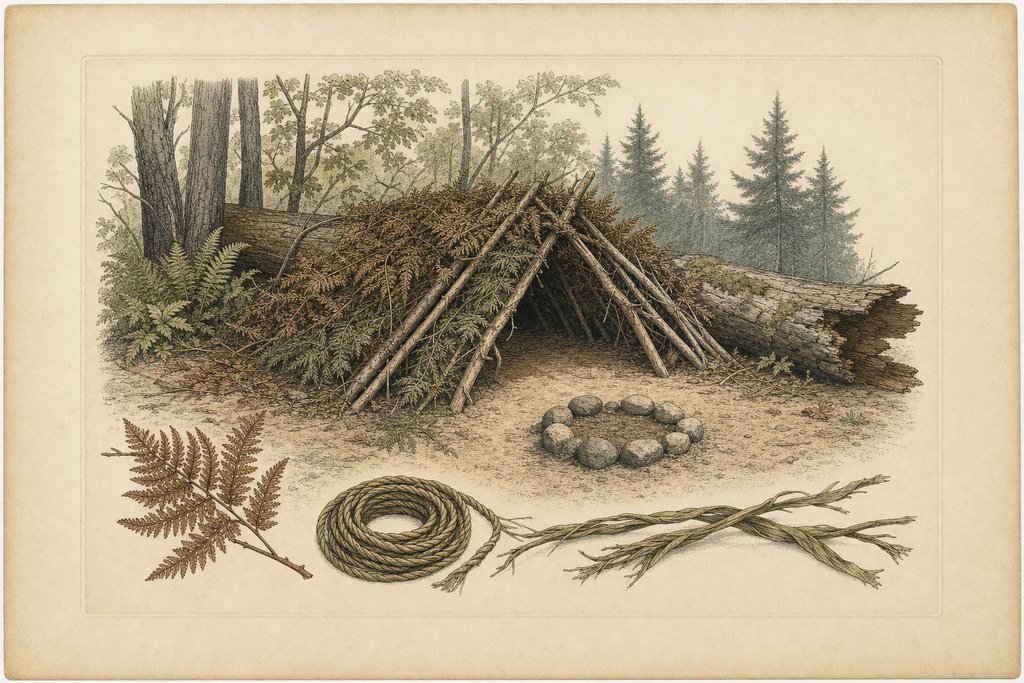
Bushcraft sessions here run across the warmer months and are pitched firmly at families instead of at survivalists, which is worth knowing before booking one. The content is fire, shelter and cordage, taught at a level that a mixed group of adults and older children can all take something from.
The ground suits it better than most sites in the county would. Pine plantation supplies dead standing wood, bracken and needle litter in quantity, and the sandy soil drains so freely that a session can go ahead on a morning after rain when heavier clay ground would be unworkable mud.
Fire is the part everyone comes for, and it is taught properly and not as a demonstration. Participants prepare their own tinder, work through the stages from spark to sustained flame, and discover that the difficulty lies almost entirely in the preparation beforehand instead of in the striking itself, which surprises most people.
Shelter building uses what is already down on the forest floor, which is both the practical approach and the responsible one. A lean-to against a fallen trunk, thatched with bracken, teaches the principles of pitch and coverage in a couple of hours without anyone needing to cut so much as a single living branch.
A session that ends well leaves very little sign that it happened. Shelters are pulled apart and the material scattered back across the floor, the fire spot is cooled and checked by hand, and anything carried in goes out again. Learning to finish properly is part of the craft, and probably the part most worth taking to other woods.
Cordage is the quiet highlight and the one most people underestimate entirely. Twisting plant fibre into something that holds weight is slow, repetitive work, and the moment when a handful of dry stems becomes genuinely usable string changes how participants look at the ordinary vegetation around them for a long while afterwards.
Everything is done under supervision on prepared ground, with fire confined to a designated spot and extinguished properly at the end. That is not merely a formality in a pine plantation on sand, where surface litter is dry for much of the year and a stray ember travels further than expected.
That dryness is the Brecks' defining trait, since this is one of the driest corners of Britain and heath fire is a genuine hazard on it. Anyone booking during a long rainless spell should ask whether the fire element will still go ahead, because a session without a live flame can still cover tinder preparation, shelter and cordage in full.
These sessions suit children of roughly eight and upwards, with an adult alongside. Younger children find the slower elements hard going, and cordage in particular asks for a level of patience that is unusual before that age, however enthusiastic they may be about the fire lighting that follows it later on.
Parents often get as much from the morning as their children do, because the skills are new to most adults too. Nobody is handed a finished result, so a parent and a ten-year-old end up working the same problem side by side at the same level, which happens less often on a family day out than it should.
Dress for the woodland floor instead of for the weather forecast. Participants kneel, sit and handle wood throughout, so clothing that can be dirtied and boots that cope with pine litter matter more than anything else, and long sleeves are sensible around bracken and dead standing timber for the whole session.
Fire lighting is also where the site's own history quietly reappears. Brandon's whole industry was built on striking sparks from flint, and a session spent coaxing a flame from tinder sits in a direct line from the knappers who shaped gunflints here for the British army by the million for well over a century.
Almost none of it needs a forest to repeat. Cordage can be twisted from garden twine on a kitchen table, and a fire steel works as well on a barbecue as on prepared ground. The sessions are pitched so that what is learned survives the drive home, which is not true of every outdoor activity.
Common questions
What age do bushcraft sessions suit?
Roughly eight and upwards with an adult alongside, though the fire element holds attention at almost any age above that. Younger children struggle with cordage in particular, which asks for a level of sustained patience that is genuinely unusual before about eight or nine, regardless of how enthusiastic they are.
Do we cut down trees or branches?
No, and that is deliberate on both practical and conservation grounds. Shelter building works entirely from material already down on the forest floor, which is abundant in pine plantation, and teaches the principles of pitch and coverage perfectly well without anyone needing to touch any living wood at all on the site.
What should I wear?
Clothing you are happy to get thoroughly dirty, and boots that cope with pine litter and sandy ground. Participants kneel, sit and handle wood for most of the session, and long sleeves are sensible around bracken and dead standing timber whatever the weather happens to be doing on the day itself.
Does rain cancel a session?
Light rain rarely does, because the sandy ground drains quickly and finding dry tinder under a damp canopy is a useful lesson in itself. High wind is the real threat, since forest sites close at short notice when it blows hard. Check with whoever runs the session on the morning before setting out, particularly for longer journeys.
Written by Eleanor Hollis, walks and access editor. Session content varies with the organisation delivering it and with the season, so this describes the shape these events generally take; dates, ages, prices and booking arrangements all come from West Suffolk Council and from the individual organisations providing each session on the day.